
Direct answer
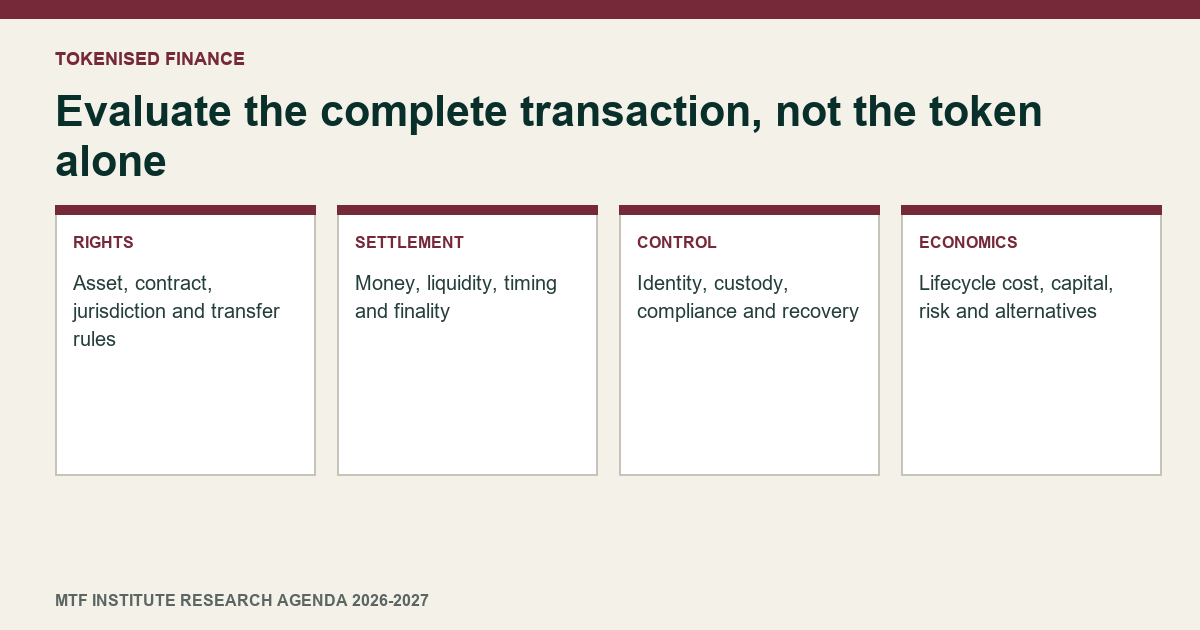
Tokenisation deserves management attention when it changes settlement, ownership records, liquidity, programmability or reconciliation. It does not create value merely because an asset is represented on distributed infrastructure. The 2026-2027 research priority is to compare complete operating models, including legal finality, cash, identity, controls and failure recovery.
Evidence base
The Bank for International Settlements has examined tokenisation within the monetary and financial system and continues experimental work through Project Agorá. These initiatives provide institutional evidence that programmable and tokenised infrastructure is being tested. They do not prove that every public blockchain, cryptocurrency or Web3 business model is efficient or appropriate.
| Layer | Question | Evidence to collect |
|---|---|---|
| Asset and legal rights | What right does the token represent? | Contract, registry, jurisdiction and transfer rules |
| Money and settlement | What constitutes final payment? | Settlement asset, timing, liquidity and reversal |
| Identity and compliance | Who can hold or transfer the asset? | Onboarding, sanctions, permissions and audit trail |
| Technology and operations | How does the system recover from failure? | Keys, custody, availability, reconciliation and incident response |
| Economics | Which friction is actually removed? | Baseline cost, capital use, time, error and counterparty exposure |
Research streams
Tokenised deposits and wholesale settlement
Compare transaction speed, liquidity demands, reconciliation work and legal certainty with existing rails. A faster technical transfer may still require slow exception handling or duplicate records.
Digital assets and treasury governance
Study custody, concentration, price volatility, counterparty dependencies and authority over keys. Research should make the stop conditions and loss allocation visible.
Smart-contract controls
Test the relationship between code behavior, contractual intent and operational override. Important questions include upgrade authority, oracle failure, disputed transactions and incident response.
Web3 business models
Separate genuine user coordination or market design from token incentives that temporarily subsidize activity. Measure retention and economic contribution after incentives change.
Proposed comparative method
Map the same transaction under the present and proposed systems. Record every actor, ledger, approval, reconciliation, liquidity commitment and exception. Estimate cost and time across the full lifecycle rather than the “happy path.” Conduct scenario tests for key loss, participant failure, legal dispute and network outage.
Limits
Regulation, market structure and infrastructure differ across jurisdictions. This agenda is not investment advice and does not assess the value of a cryptocurrency. Institutional experiments should not be represented as endorsement of a commercial product.
Continue learning
The capabilities examined in this report are developed in MTF Institute's Executive Certificate in Strategic Finance, M&A & Corporate Valuation through structured learning and applied practice.