
Direct answer
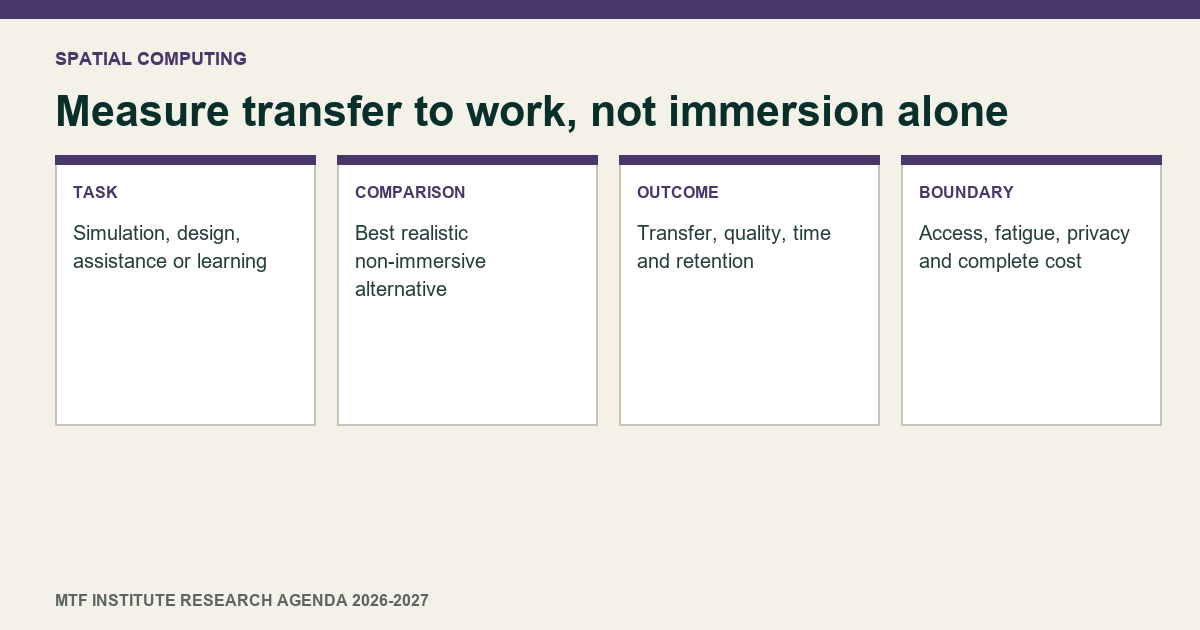
Spatial computing and virtual worlds should be evaluated as interfaces for a specific task: simulation, design review, remote assistance, training or customer experience. The relevant question is not whether an environment is immersive. It is whether immersion improves a measurable outcome enough to justify hardware, content, accessibility and operating costs.
Evidence base
The European Commission's Virtual Worlds Partnership and Virtual Worlds Observatory reflect continuing institutional attention to the field. Public programs can coordinate research and measurement, but they do not demonstrate that every workplace or consumer use case is mature.
| Use case | Outcome measure | Important comparison |
|---|---|---|
| Safety or procedural training | transfer to observed real-world performance | existing simulation, video and supervised practice |
| Design and digital twins | earlier detection of costly conflicts | standard 3D review and physical prototype |
| Remote expert support | resolution time and error | video call, documentation and local expertise |
| Collaborative work | decision quality and participation | established digital collaboration tools |
| Customer experience | qualified conversion and retention | mobile, web and physical alternatives |
Research streams
Transfer from simulation to work
Measure whether performance improves outside the virtual environment. Completion, presence and enjoyment can be useful secondary measures, but they are not substitutes for transfer.
Digital twins as decision systems
Study model fidelity, data freshness and governance. A visually persuasive twin can be dangerous when assumptions or sensor gaps are hidden.
Accessibility and fatigue
Research should include participants who experience motion discomfort, vision or mobility constraints, device fit problems or limited bandwidth. Exclusion changes both ethics and business viability.
Identity and conduct
Virtual workplaces create questions about identity, recording, harassment, monitoring and ownership of behavioral data. Controls must be designed before large-scale use.
Proposed evaluation
Randomly assign comparable learners or teams where feasible. Compare the immersive intervention with the best realistic alternative. Measure immediate task performance, delayed retention, transfer to work, time, adverse effects and complete delivery cost. Report dropout and device failure.
Limits
Hardware and software change quickly, so results may not transfer across systems. Novelty can temporarily increase engagement. The agenda does not treat a higher engagement score as proof of learning or productivity.
Continue learning
The capabilities examined in this report are developed in MTF Institute's Executive Certificate in AI, Digital Transformation & Platform Strategy through structured learning and applied practice.