
Direct answer
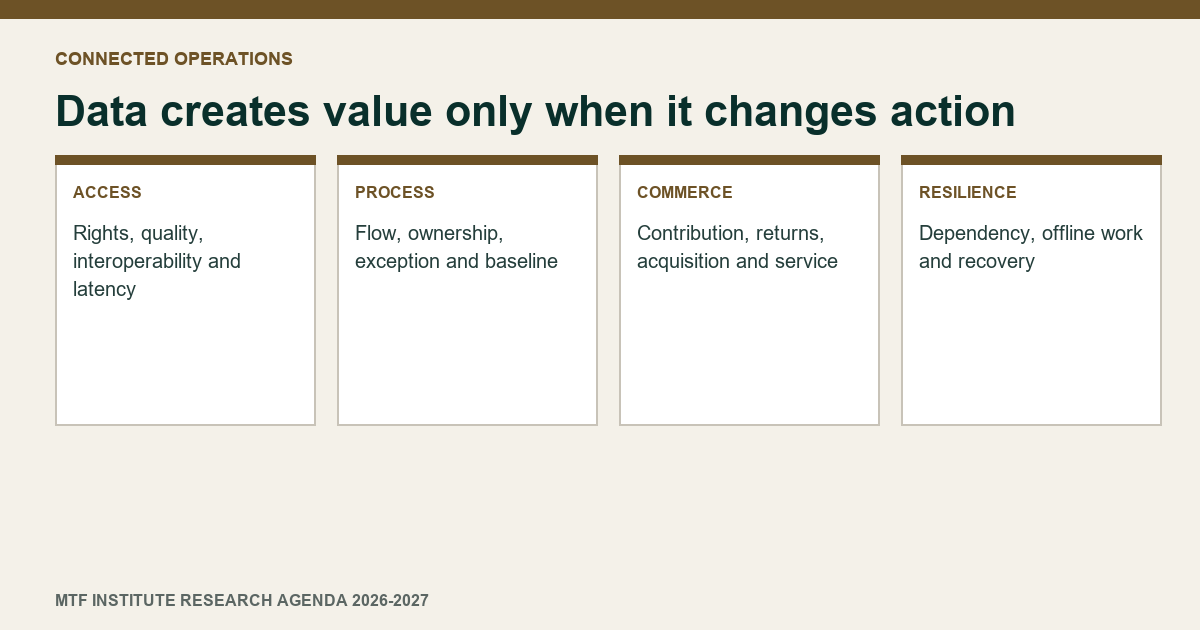
Connected devices and digital commerce create value when their data improves a decision or removes avoidable coordination. More data is not automatically better operations. The 2026-2027 agenda focuses on data rights, interoperability, process redesign, resilience and measurement across the physical and digital customer journey.
Evidence base
The European Data Act changes access and use expectations for data generated by connected products. UNCTAD continues work on measuring e-commerce and the digital economy, where inconsistent definitions can make country or market comparisons difficult. The European Digital Decade reporting package provides a policy view of digital progress. Together, these sources point to a need for operational research that is explicit about definitions and data provenance.
| Domain | Management question | Failure mode to test |
|---|---|---|
| IoT data access | Who can use device data, for which purpose and under what terms? | Data is technically available but unusable or legally restricted |
| Predictive maintenance | Does an alert improve uptime after false positives and response capacity? | More alarms create work without preventing failure |
| Digital commerce | Which channel activity contributes to profitable demand? | Revenue attribution ignores returns, incentives or acquisition cost |
| Supply chain visibility | Does visibility change action early enough? | Dashboards describe disruption after the decision window |
| Automation | Which exception requires accountable human review? | Process speed increases while hidden errors accumulate |
Research streams
Connected-product data contracts
Examine how product design, customer rights, supplier agreements and platform APIs determine practical access. Research should document data dictionaries, latency, quality and the cost of making data decision-ready.
Operations before automation
Compare automation with process simplification. A study should map handoffs, queues, rework and exception frequency before adding sensors or AI. The most valuable intervention may be a clearer rule or owner.
E-commerce economics
Measure contribution after discounts, media, payment fees, fulfillment, returns and support. Channel growth that consumes cash or creates costly service demand should not be reported as unqualified digital success.
Resilience
Connected systems increase observability but also dependency. Test offline operation, vendor failure, compromised devices, data delays and recovery time.
Proposed field study
Choose one operating process and one digital customer journey. Establish a four-week baseline. Introduce one information or workflow change at a time. Measure lead time, error, cost, customer outcome and employee workload. Preserve a log of exceptions and unintended consequences.
Limits
Sector practices and data rights differ. The presence of a sensor, API or digital channel does not demonstrate causal impact. Research should report adoption and operating behavior, not only technical availability.
Continue learning
The capabilities examined in this report are developed in MTF Institute's Executive Certificate in Operations Management and Supply Chain through structured learning and applied practice.